How to Style Open Shelves Without Clutter: A Room-by-Room Guide
Open shelving is honest. Everything on it is visible, which is why it looks wonderful when it works and chaotic when it doesn't. The good news is that styled shelves are rarely about buying more beautiful objects. They are about deciding what each shelf is for, then leaving enough bare space around those things for them to register as a display rather than a storage problem. These are the rules that do the heavy lifting, room by room.
Four rules that do most of the work
Before you move a single vase, decide what job the shelf is doing. A shelf beside the hob is storage. A shelf above the sofa is decoration. Trying to make one shelf do both is where clutter begins.
- Group in threes. Odd numbers of objects settle the eye. Two feels like a pair waiting for a third; five starts to look like a collection.
- Vary the height. A tall vase, a medium stack of books and a low bowl will always look better than three objects of the same size lined up like soldiers.
- Leave roughly a third empty. Negative space is not wasted space. It is what makes the objects you have chosen look deliberate.
- Repeat one thing. A single colour, one material or a matching pair of bookends running across the whole unit makes unrelated objects feel as though they belong together.
If you remember only one thing, make it this: a good shelf looks as though someone with taste put a few things down and walked away. It should not look as though someone spent an afternoon arranging it.
Kitchens: keep it useful, then make it pretty
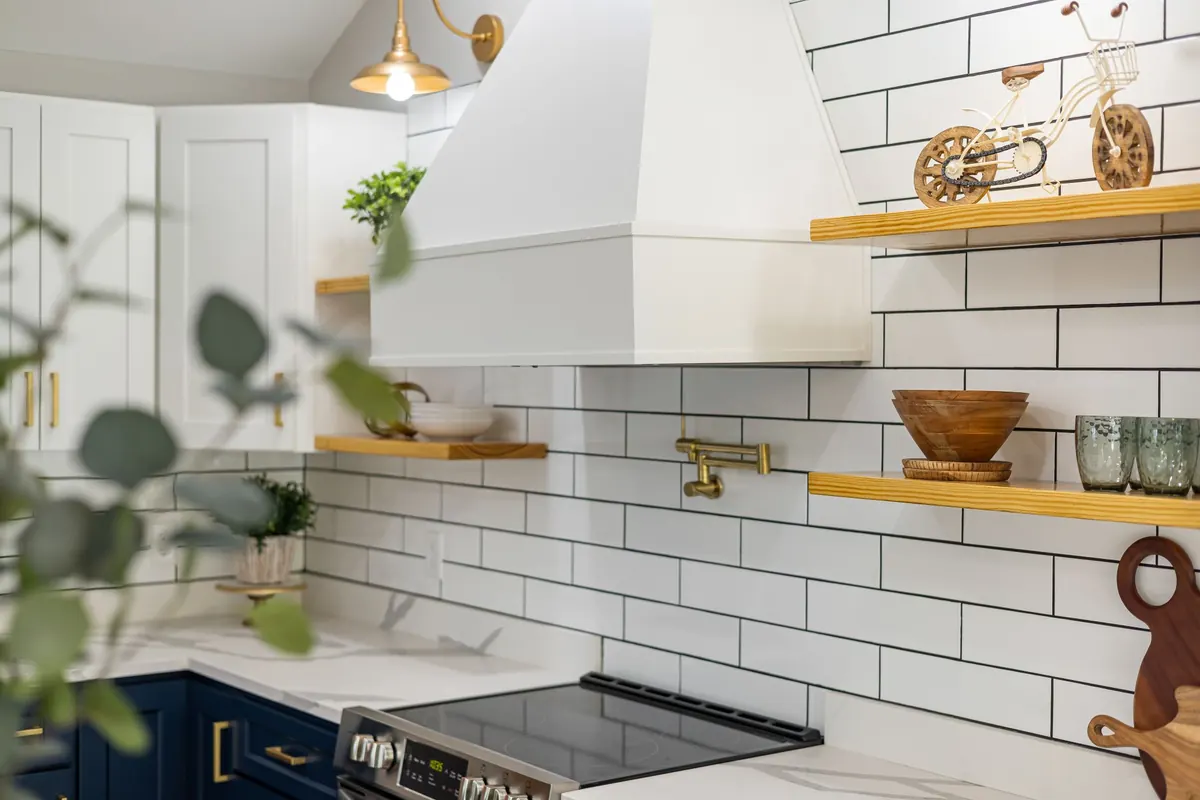
Kitchen shelves have the hardest job of all, because the things on them get used every day. Start with function and style around it.
What earns its place
Mugs you actually drink from. Oils and vinegars decanted into matching bottles, which also makes them easier to pour. A shallow bowl for lemons or garlic. Plates stacked no more than two deep, since taller piles read as a shop display rather than a home. Jars of pasta and rice, filled to roughly the same level so the line stays tidy.
What to move elsewhere
Anything still in packaging you would hide in a cupboard. Duplicates. Cleaning products. Tea towels that never make it back to the drawer. If it is ugly and you do not use it weekly, it does not belong on an open shelf.
Keep food shelves away from the hob where you can. Grease settles on ceramics, paper and glass, and a shelf you have to scrub weekly stops feeling like a pleasure. Herbs and small trailing plants look lovely near a window, but check the drop first: a plant that dangles into your chopping space will irritate you within a week.
If it is not used weekly and it is not lovely, it lives in a cupboard.
Living rooms: books, ceramics and a little greenery
Living room shelves can carry more personality, but they still need an anchor. Books are the easiest one. Stack three or four horizontally to break up a row of upright spines, and use bookends where a vertical run needs to stop. Turning two or three covers face out adds colour and draws the eye without effort.
Ceramics work best in small, deliberate groups. A trio of vessels in related tones, one tall and two low, looks considered. A row of twelve looks like a car boot sale. If you collect small pieces, corral them on a shallow tray so they read as one object rather than six.
Plants need more restraint than people expect. One generous plant per bay, or two small ones at opposite ends, is usually enough. A trailing variety on the top shelf softens the whole unit; an upright one on a middle shelf adds height. Grouping five small pots together rarely works, because the eye reads the clutter of rims before it reads the greenery.
Finally, deal with the cables. Tuck chargers behind a row of books, or run them down the back of the unit. Nothing undoes a styled shelf faster than a visible plug.
Bedrooms: fewer things, softer edges
Bedroom shelves should help you wind down, so aim for calm rather than interesting. A bedside shelf might hold a small lamp, one book, a dish for earrings and a single small plant. That is already four items. Try three and see whether the shelf feels better.
Keep paperwork, chargers and laundry off these shelves entirely. If the shelf sits above the bed, choose low, stable objects and avoid anything heavy that could fall. A framed print leaning against the wall is fine; a stack of hardbacks balanced on a narrow ledge is not.
Where a bedroom has a full wall of shelving, treat the top third as display and the lower shelves as storage, perhaps with baskets or boxes at the bottom. The eye travels upward, so the tidiest part of the unit should sit at the top.
Negative space: how much is enough?
Stand two metres back from the unit. If you cannot see the back of the shelf anywhere along its length, take something off. Photograph it on your phone, too — a camera flattens a shelf in much the same way a visitor's eye does, and the clutter shows up immediately.
Where you leave the gap matters as much as how much you leave. A gap at the end of a shelf looks intentional; a gap in the middle of a group looks like something fell over. Aim for breathing room at both ends of each shelf, and slightly more space around your largest object so it does not feel crowded by its neighbours.
Rotate, don't accumulate
Shelves go stale. A seasonal swap takes minutes and makes a room feel new: heavier ceramics and darker book jackets in autumn, glass, pale linen and fresh greenery in summer. Keep a box in a cupboard for whatever comes off.
Follow a one-in, one-out rule. Something new arrives, something old goes away. Without that discipline, open shelving quietly becomes an archive, and no amount of clever arranging will disguise it.
A ten-minute reset
When a shelf has drifted, work through this in order and stop when it looks right.
- Empty one shelf at a time onto the floor, rather than dismantling the whole unit.
- Put back only what you love or use weekly. Everything else goes in the box.
- Group in threes, vary the heights, and repeat one colour or material across the shelf.
- Step back, then remove one more object. It is almost always the right call.
- Dust as you go, and wipe the shelf edges — open shelving shows every mark.
Do one shelf a week rather than the whole room in an afternoon. Small, regular edits keep a display alive, and they are far easier to live with than a single heroic tidy-up that you never want to disturb again.
Photo: Curtis Adams / Pexels

You Might Also Like
A practical guide to no-drill shelving for UK renters: tension poles, adhesive strips, freestanding units and removable fixes, with fitting tips and deposit-friendly habits.
A practical guide to sanding, priming, painting and sealing wooden shelves so the finish survives mug rings, chips and years of use.